
Learning Style in Production Engineering: Through the Index of Learning Styles (ILS)
Few academics develop their research with evening students. this students work on the day and dedicate their weekend to their families, a consequence they have shor time for after-college activities. Addressing research topics with these groups is a complex task, but not impossible. This research proposed a strategy that allowed the analysis of the concept of "quality" through the study of contextualized problematic situations (ESPC). This strategy was based on the dominant learning style of the experimental group according with Felder & Silverman's model. Through the Index of Learning Styles (ILS), the dominant learning style of the target group was determined; the student's commitment and the teacher's work in the classroom were evaluated by means of a questionnaire; and finally, the impact on academic performance was established.

CvLac
The Curriculum vitae for the Caribbean and Latin America is the record of the research activity of a professional linked to a research group. It lists the bibliographic publications endorsed by MinCiencias in the Announcement 894 of 2021.
My classification as a researcher in Announcement 894 of 2021 was as a junior researcher.
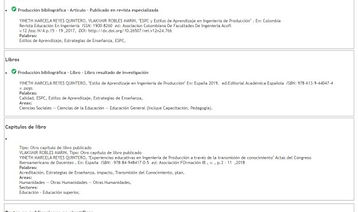
Impact of pedagogical training strategies and systematization of teaching practice on the academic training of university students.
An educational innovation project was structured and submitted for evaluation and became a point of reference within the Colab directory for other teachers.

Mentoring
Importance of tutoring in college students

It was designed a strategic starting of dominant style of learning through the Studies of Contextualized Problem Situations (ESPC, for its acronym in Spanish), to teach the concept of quality. Participated 30 first semester students from the Production Engineering program of the night class of the 2016 period. The results show a positive impact on the academic achievement of the target group compared to the experimental group. The difference of the arithmetic mean in the scores obtained by the groups were significant

Educational experiences in production engineering through the transmission of knowledge.
the paper is result of two years work´s. this work was develop with four groups of students belonging to public university. The work was divide on two phase: The first stage, addresses the students of the elective course "clean production", who lived an experience of transmission of knowledge with the stakeholders of the institution where the research was develop. The principal objective was raise awareness in the community about the environmental aspects and the Consumer's role. Seventy-three students took part to research, between 20162 and 20172. Themselves were organized in groups, assigned leaders, looked for concrete problems to approach, planned the approach of the community, developed the planned strategy and they evaluated its application; the second stage, the leaders of each group were interviewed to know their perceptions and opportunities for improvement. The above through ten pairs to avoid teaching-teacher bias.

Igniting circularity and sustainability in the fashion industry through collaboration
Volunteer

ACKNOWLEDGMENTS
Awards for work performed

Agreement
IPR 020-2021
For fulfillment of the academic work related to the development and strengthening of the pedagogical strategies of the different programs of the School of Production Engineering.

Acknowledgments
Junior Researcher
For commitment to research and technological development, innovation and artistic and cultural creation, and knowledge management.